

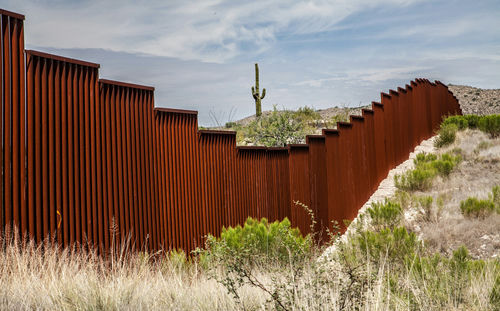
Federal border wall agents are telling West Texas families to open their gates or risk losing generations-old land in court.
Story Snapshot
- Texas law blocks state seizure of land for its border wall, but federal agencies still lean on eminent domain.
- West Texas ranchers now face “right-of-entry” offers that warn of condemnation lawsuits if they refuse access.
- Past wall projects show sloppy surveys, lowball payments, and years-long court fights for landowners.
- Trump’s push to secure the border must now balance real security needs with core property and due-process rights.
Federal Power Meets Texas Private Property
Texas land along the Rio Grande is mostly private, passed down through families who have worked it for generations.[4] When Washington decides to build steel and roads, that history collides with federal power. Congress gave the Department of Homeland Security authority under border laws to build barriers and even “buy any interest in land” needed for security, including by using eminent domain, the government power to take land for public use.[1][3] That legal power is real, but how it is used is what worries many conservative landowners most.
Reports say Customs and Border Protection has mailed right-of-entry construction offers to Texas landowners, sometimes with signing bonuses of up to $5,000.[2][6] The letters outline three paths: sign and allow access now, try to negotiate a sale later, or wait for Justice Department lawyers to file a condemnation case.[3][6] For a ranch family, that is not a free choice. It feels like a threat: cooperate on the government’s timeline or prepare to fight Washington in federal court with your own time and money.
State Limits, Federal Pressure, and Landowner Resistance
Texas leaders responded to past abuses by blocking the state from using eminent domain for its own border wall program.[4][5] Lawmakers required that Texas rely on voluntary easements, so the state must pay a one-time fee and cannot simply seize land for wall segments.[4][5] That change was meant to protect property rights. It has teeth: at least a third of landowners approached for the state wall have refused easement deals, forcing Texas to build in remote stretches and leave gaps where families said no.[4][5] That resistance shows border ranchers are willing to stand their ground.
Federal agencies, however, play by different rules. The federal government still claims the power to condemn private land along the southern border when negotiations fail, so long as it pays what courts call “just compensation.”[4][12] In practice, that often means a Declaration of Taking filed in court, which can let Washington seize control of land as soon as a judge signs an order, before the final payment fight is finished.[4] For landowners, the message is clear: even in a conservative state that values property rights, the federal bulldozer can still show up first and argue about price later.
Lessons From Past Border Wall Takings
History gives landowners good reasons to be skeptical. A fact sheet on southern border seizures notes that after earlier wall laws, the federal government filed more than 360 eminent domain lawsuits against property owners, including 334 in South Texas alone.[4] More than a decade later, roughly 60 to 70 of those cases were still unresolved because of disputes over compensation.[4] That means many families saw the wall built on their land while they sat in legal limbo, still arguing about what their property was worth after the fact.
In far West Texas, the threat of land seizures for a border wall has families on edge.
In the Big Bend region, where some families have lived for generations, government letters seeking access to their land is sparking fear and resistance. https://t.co/iM6GEXs14i
— Texas Tribune (@TexasTribune) June 16, 2026
Investigations have found serious mistakes and shortcuts in those earlier takings. One joint review by reporters described Homeland Security waiving safeguards meant to protect owners, raising the dollar threshold that required formal appraisals.[4][9] That move let the government avoid full appraisals for many small tracts, making it easier to lowball offers. In some cases, officials even paid people who did not own the land, then had to pay again once they found the real owners.[9] For conservative readers, this looks like classic big-government incompetence mixed with raw power.
New Lawsuits and a Test for Constitutional Limits
Current Big Bend landowners are not just rolling over. A new lawsuit backed by advocacy groups and a local landowner challenges the way the Department of Homeland Security used its waiver authority to fast-track wall construction in the region.[2] The suit argues that the agency went beyond what Congress clearly approved, raising what courts call “major questions” about economic and political impact that require explicit legislative backing.[2] In plain terms, they claim Washington cannot rewrite entire chunks of law on its own just to pour concrete faster.
Under earlier border statutes, Homeland Security secretaries have waived dozens of environmental, cultural, and procedural laws to speed up wall work.[1][2][15] Some waivers even cut back protections that were supposed to ensure fair treatment and proper notice for landowners.[4][9] That history matters now, because every time an agency sidesteps process, it feeds the sense that regular citizens have no voice. For a movement that values the Constitution and limited government, a cabinet secretary with power to waive “all legal requirements” should set off alarms, even when the goal is border security.
How Trump Supporters Can Back the Wall and Defend Property Rights
Trump voters have long demanded a real border barrier to stop cartels, smugglers, and illegal crossings. They are right that a nation without a secure border is not truly sovereign. But they are also the people most likely to own the ranches, farms, and riverfront tracts now in the government’s sights. Past guidance from property-rights attorneys stresses that landowners usually cannot stop a taking altogether, but they can slow the process and fight for full payment.[14] That means getting their own appraisals, documenting every impact, and not rushing to sign one-sided deals.
For West Texas conservatives, the real question is not “wall or no wall.” It is whether Washington will respect due process, honest valuations, and the Fifth Amendment promise of just compensation while it builds the wall they asked for.[4][12][14] The track record on the border is mixed at best, with sloppy surveys, secret waivers, and years of unfinished cases hanging over families.[4][9] If this administration wants to secure the border and keep the trust of its own base, it must prove that national security does not mean steamrolling the very Americans who live on the front line.
Sources:
[1] Web – Texas Landowners Face a Difficult Decision: Allow Border Wall or Lose …
[2] Web – DHS waives certain legal regulations to expedite border wall …
[3] Web – Lawsuit Challenges Big Bend Border Wall Construction
[4] Web – [PDF] obstructing human rights: the texas-mexico border wall
[5] Web – [PDF] Eminent Domain Along the Southern Border: Government Seizures …
[6] Web – Official Border Wall plans have been released for the Big Bend. If …
[9] Web – As landowners resist, Texas’ border wall is fragmented and built in …
[12] Web – Zapata County landowners say border wall contractors … – TPR
[14] Web – Texas Landowners Dig In to Fight Trump’s Border Wall – VOA
[15] Web – Texas landowners in the Big Bend region are fighting federal efforts …