

The U.S. Coast Guard fired on and disabled a suspected Chinese smuggling boat near Florida — and new rules mean officers no longer have to wait for permission from the top before pulling the trigger.
Story Snapshot
- The Coast Guard opened fire and disabled a vessel reportedly linked to Chinese smuggling activity near Key Biscayne, Florida.
- New 2026 rules now let Coast Guard officers and boat commanders use force on their own — no flag officer approval needed.
- The Coast Guard has seized hundreds of millions in drugs off Florida’s coast in recent months, showing how active this fight has become.
- Key details about the boat, its crew, and the cargo have not yet been confirmed by official sources.
Coast Guard Opens Fire Near Key Biscayne
The U.S. Coast Guard (USCG) fired warning shots and then disabled a vessel suspected of smuggling near Key Biscayne, Florida. Reports describe the boat as linked to Chinese nationals, though the Coast Guard has not yet released an official incident report confirming the vessel’s identity, cargo, or crew. What is clear is that the Coast Guard operates aggressively in this area. In May 2026, officers seized a vessel loaded with cocaine worth $6.7 million just off Cape Florida.
The South Florida coast is one of the busiest maritime enforcement zones in the country. The Coast Guard’s Southeast District handles rescues, drug busts, and immigration stops on a near-daily basis. [4] Officers there have been on high alert, especially with the FIFA World Cup 2026 bringing added security pressure to Biscayne Bay from June through July. [2] That backdrop makes a use-of-force interdiction in the area fully consistent with current operations.
New Rules Put Power in the Hands of Front-Line Officers
In March 2026, Acting Commandant Admiral Kevin Lunday changed how the Coast Guard handles non-compliant vessels. Before this change, a boat commander had to get approval from a flag officer — a senior admiral — before using force to stop a fleeing boat. That process took time. Under the new Surface Use of Force rules, commanding officers and pursuit boat drivers can now make that call themselves if a vessel refuses to stop. [18]
The new policy works in steps. Officers first issue warnings. They then try other tactics to slow the boat. If those fail, they can fire into the vessel’s engine to disable it. In one documented case under the new rules, an officer fired four rounds into an outboard motor, stopping the boat. When boarded, the vessel held eight migrants. The boat was towed in and the migrants were handed over to Border Patrol. [18] That step-by-step approach reflects the Coast Guard’s long-standing principle: use the minimum force needed to get the job done.
A Long History of Stopping Smugglers at Sea
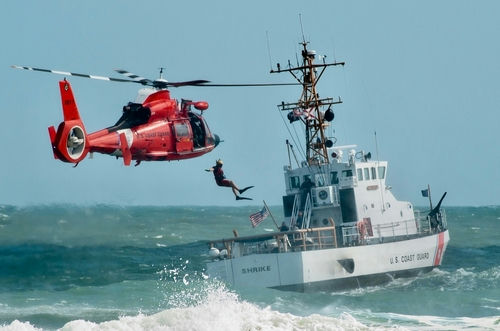
Warning shots and disabling fire are not new tools. The Coast Guard used them to fight rum runners during Prohibition in the 1920s. The practice was later expanded to include airborne use of force from helicopters, authorized in 1999 after drug smugglers changed tactics to outrun surface vessels. [19] The Coast Guard’s Helicopter Interdiction Tactical Squadron — a specialized airborne law enforcement unit — is trained and authorized to use force from the air. [9]
The scale of the drug fight off Florida’s coast is staggering. In April 2026, the Coast Guard Cutter Escanaba offloaded 7,050 pounds of cocaine worth more than $53 million at Port Everglades. [1] In March, the Cutter Forward brought in another 6,570 pounds worth over $49 million. [1] These are not isolated wins — they reflect a sustained, well-resourced enforcement campaign that is producing real results under the Trump administration’s border security push. The incident near Key Biscayne fits squarely into that larger mission, even as the specific details of this case remain incomplete pending an official report.
What We Still Don’t Know
The biggest gap in this story is the lack of an official incident report. No confirmed details have been released about the vessel’s name, flag, route, or what was found on board. The “Chinese smuggling boat” label comes from early reports, not a verified Coast Guard statement. Until the agency releases its boarding records, use-of-force report, and seizure documents, the full picture remains unclear. That is not a reason to doubt the interdiction happened — it is a reason to demand the facts be made public quickly.
Sources:
[1] Web – New: Coast Guard Opens Fire, Disables Chinese Smuggling Boat
[2] Web – United States Coast Guard
[4] Web – 2026 U.S. Coast Guard Outlook Summit – Defense Leadership Forum
[9] Web – Coast Guard Prepares to Cut Up to 12 Flags by 2026 … – Reddit
[18] Web – Key Biscayne – WPLG Local 10
[19] Web – One person was taken to the hospital on Saturday after a vessel in …