

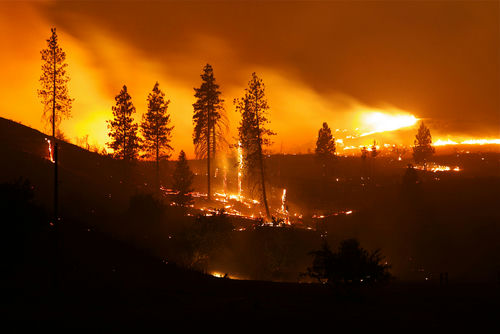
The Aspen Acres Fire did not just torch forested hillsides in southern Colorado; it exposed how one human spark can upend entire towns, test government promises, and leave families wondering who will help them rebuild when the cameras move on.
Story Snapshot
- A human-caused wildfire exploded into one of Colorado’s largest fires on record
- Thousands fled mandatory evacuations as more than 160–200 structures were destroyed
- Governor Jared Polis declared a disaster emergency to unlock state and federal aid
- Many displaced families now face ruin with little insurance and long odds of fast recovery
How One Fire Turned Quiet Mountain Towns Into A Disaster Zone
The Aspen Acres Fire started on Monday, June 29, near a small campground area in Custer County and raced into neighboring Pueblo County, pushed by dry fuel and powerful winds. Within days it had burned tens of thousands of acres with zero containment, forcing sheriffs to order mandatory evacuations for Beulah, Rye, San Isabel, Wetmore, Colorado City, and the Red Creek area. Longtime residents who thought they knew fire season watched a wall of flame erase that confidence in a single week.
As the fire grew, the map looked less like a local problem and more like a regional threat. Officials reported 35,000 acres burned on July 1. By Friday, perimeter mapping put the size near 55,000 to almost 67,000 acres, depending on the reporting source. That range matters to scientists, but the lived reality was simple for people on the ground: entire valleys went from green to black, and smoke pushed air quality alerts across most of the state. The blaze climbed into the list of top 10 largest fires in Colorado history.
Homes Lost, But Families Still Kept Outside The Ruins
Structure loss numbers tell only part of the story, but they are still brutal. Sheriffs in Pueblo and Custer counties confirmed around 180 structures destroyed, and other official mapping estimates suggest more than 200 may be gone across both counties. Some neighborhoods saw a “hit-or-miss” pattern, where one house still stood while the next was leveled to the foundation. At the same time, law enforcement kept residents out of the burn scar because downed lines, unstable trees, and hot spots made it too dangerous to enter. Families had to wait, knowing something might be gone but not allowed to see which.
Officials report no civilian deaths so far, and only one firefighter injury, which is a blessing in a fire this size. That fact can feel strange next to video of whole streets turned to ash. For an American conservative reader, it raises a fair question about priorities: if we can move people out in time, why do we still fail so often on prevention and hardening homes before the spark? That is not an accusation against firefighters, who did their jobs with courage; it is a question for policy makers who talk about “climate” but dodge land management and local responsibility.
Human-Caused Fire, But Officials Still Guard The Details
Fire officials have said clearly that Aspen Acres was human-caused. That does not necessarily mean arson; it can mean a vehicle, a power issue, a careless campfire, or improper equipment use. Right now, they have not told the public what happened, only that the cause is under investigation and the exact ignition point is still being studied. This kind of partial transparency is common in major fires. It protects the investigation, but it also leaves a vacuum that rumors and online speculation rush to fill.
From a common-sense, right-of-center view, this is where trust can start to fray. People see that one human action set off a disaster that now justifies emergency declarations, big spending, and new rules. They have a right to know whether that action was criminal, negligent, or just bad luck. Until those facts come out, it is wise to hold off on blame. But it is also fair to demand that agencies release the full cause report once it is ready, instead of burying it under jargon and legal excuses.
Evacuations, Aid, And The Hard Math Of Rebuilding
The evacuation orders read like a checklist of small-town America: Lazy Acres, Bishops Castle, Hatchett Ranch, Red Creek Ranch, and stretches of Highway 78, 96, and 165 all fell under mandatory or pre-evacuation status. Buses moved elderly residents from Rye to shelters in Pueblo. The main evacuation center opened at the Pueblo County Recreation Center on Cooper Place, while large animals went to the Colorado State Fairgrounds. For a time, none of the orders were lifted, which meant people lived out of cars, churches, and school gyms, waiting for news.
Governor Jared Polis declared a disaster emergency, which helped unlock more fire crews, air tankers, and federal aid dollars to fight the blaze and support evacuees. Over 300 personnel, including an Alaska-based incident management team, were assigned, along with multiple large air tankers when winds allowed flying. That response, backed by taxpayers, is the right use of government power. But the next phase is harder and less flashy: rebuilding lives in a world where many mountain homeowners either could not get fire insurance or dropped it because premiums were too high. Those families now face a choice between starting over from savings or walking away.
Media Narratives, Geography Confusion, And What Comes Next
National headlines framed Aspen Acres as a wildfire “southwest of Denver,” which is geographically loose at best. The fire sits roughly 150 miles south of the city, near Colorado City and Beulah, in Custer and Pueblo counties. That kind of broad phrasing can mislead readers into thinking Denver itself was under direct threat. The bigger problem is not a map error; it is how dramatic language—“massive,” “apocalyptic,” “unprecedented”—can outrun the still-developing facts on structure counts and cause.
NEW: Aspen Acres fire grows to 55,392 acres, making it a top-10 biggest Colorado wildfire on record. It passed the 416 fire (2018) for 10th-biggest fire on record.
55,392 acres = 86.5 square miles = more than half size of the city of Denver. #COwx pic.twitter.com/NEsfhYXfmZ
— Chris Bianchi (@BianchiWeather) July 3, 2026
There is no serious public “Side B” disputing that the fire is huge, human-caused, and destructive. The debate instead focuses on unanswered questions: the precise ignition, the final number of homes lost, and whether agencies will stay honest once the cameras turn away. For people who value local control, property rights, and personal responsibility, the next steps matter as much as the fire itself. They will watch to see if officials blame only “dry conditions,” or whether they admit where human error, planning failures, and red tape made a bad situation worse—and then fix it before the next spark flies.
Sources:
washingtontimes.com, denver7.com, fires.cornea.is, nytimes.com, facebook.com, pbs.org, youtube.com